
The Thirties – the Littlewoods at Hollycroft in Adel, Leeds
The Thirties was a bad time for many people in many countries. America and Britain were in a severe economic depression, the Spanish civil war started. Hitler, came to power in 1933 in Germany and was invading other parts of Europe with a major war coming ever closer. In Britain there were hunger riots in 1932 although “whipping of children under 14 years was declared illegal”. So times were very bad for very many people in the Thirties. Apparently the average family in the UK needed £6 a week to remain above the poverty line but the average weekly wage in 1936 was only £2. In some parts of the UK almost 7 out of 10 men were out of work.
However, as a young child in the Thirties, born in 1932, during my first 8 years I was blissfully unaware of all these problems until war with Germany was declared in 1939. This may have been in part due to the lack of the intensive media cover of such events that we receive in recent times.

I often wonder how it was that we had such a comfortable life at that time when so many people were having such a miserable time. I suspect it was that my father had a steady job having risen from a clerk at the Leeds branch of the Century and Friends Provident Insurance Company to be the manager of both Leeds and Bradford branches and my mother had a very successful hairdressing and beauty business in the centre of Leeds – The Misses Walker – witch she had started in 1914.
In 1914 my mother had started a hairdressing and beauty business, “The Misses Walker”, in the centre of Leeds at the junction of Commercial Street and Lands Lane. By the Thirties there was obviously a very wealthy clientele. Mother told of clients being delivered and called for by their chauffeurs. They appeared to be dealing with “well off” clients from many of the leading families in the area.
Mother knew Lord Moynihan, the famous Leeds surgeon, quite well, not only through the Leeds Amateur Operatic Society, where his daughter Dorothy was an active member, but also through providing hair and beauty services to many of his wealthy patients who came to Leeds for surgery from around the country and also from the United States of America. The patients would be operated by Lord Moynihan in his nursing home in Clarendon Road near the Leeds General Infirmary. He would say to my mother “I’ve done my job – now it’s up to you to get them going and back to good health!”.

Mother or one of her senior assistants would go in daily to do their hair and give various beauty treatments. This appeared to be a successful working relationship as Moynihan eventually asked my mother to start a branch associated with his nursing home in London; however, she decided to remain with her family in Leeds.

Lord Moynihan (1866-1936) was undoubtedly Leeds’s most distinguished surgeon and apparently a most impressive person. You can imagine, as my mother knew him well, that he was mentioned frequently to me as an example of a career target!!! I had to keep reminding mother that he was a world leader in surgery and someone very special and I was just an average boy! The expression “Lord Moynihan used to say….” was a frequent start to piece of maternal advice for me on a wide variety of topics in my childhood. However, in summary, the working relationship and the family connections through the Leeds Amateurs with Lord Moynihan obviously had a favourable effect on The Misses Walker’s undoubted success in Leeds; so, indirectly, he was a significant influence on our family – particularly on my mother.
Mother was involved with Moynihan’s hands in that she would manicure them. Moynihan carried the principle of keeping his hands clean far beyond the operating theatre. He had them manicured once or twice a week and wore cotton gloves while going about his ordinary activities. He would say that “the perfect surgeon must have the heart of a lion and the hands of a lady, not the claws of a lion and the heart of a sheep”. Or again, ” Infinite gentleness, scrupulous care, light handling and purposeful, effective, quiet movements which are no more than a caress, are all necessary if an operation is to be the work of an artist and not merely of a hewer of flesh.”


“The Misses Walker” busines was so named as two of mother’s sisters, Rose and May, also worked for her in the business at various stages. Mother told me that the income from the Misses Walker was considerably the larger part of our family’s income. Mother was undoubtedly a very successful business woman and sales person – relatively uncommon in those days when the most women were “housewives”. Also, it was very unusual in 1914 for a woman at the age of 24 years to start a new business in the centre of Leeds that eventually became so very successful. Among my school friends I had the only mother who “went out to work.” With two working parents we also appeared to be the most “well off” – with two maids, two cars and two houses!
James was born at Hollycroft, Adel, Leeds in 1932
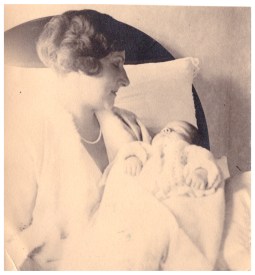
Mother was 42 years old when I was born – quite old for having a baby – particularly for a home delivery; most babies were born at home at that time and our family, unlike many, could afford medical care – there was no National Health Service until 1948. However, provided the mother was healthy and the birth expected to be normal, home delivery was perhaps preferable in those pre-antibiotic days as the risks of infection, the much feared puerperal fever, were high in hospital and lower at home.
Addendum – Some relevant information about midwifery from the Thirties
As I am one of the ever decreasing number of living individuals who were born in the early Thirties when the state of midwifery and risks to the mother in the UK were a causing increasing concern, it seemed reasonable to discuss the situation and major changes that occurred during the Thirties to improve matters.
Infection of the mother’s birth canal after delivery – causing puerperal fever – was a very serious, commonly fatal, complication in the pre-antibiotic era of the Thirties. Most feared was the Group A haemolytic streptococcus, undoubtedly the cause of most of the institutional epidemics of puerperal fever in earlier years. At this time in the UK there was increasing national concern about maternal mortality. Having a baby was a dangerous business in Britain during the 19th century, one pregnancy in 200 resulted in the mother’s death. Surpriseingly, this was still the case in 1932, when the maternal mortality rate in the UK remained at 4.3 maternal deaths per 1000 births (1.6 from maternal sepsis and 2.7 from “accidents of childbirth”). These deaths were particularly tragic as many of the women who died giving birth already had a family and would leave a husband and young family.

Surprisingly, poverty and associated malnutrition appeared to play little part in determining the maternal mortality rate. This view was supported by much evidence, including the fact that, unlike infant mortality rates, maternal mortality rates tended to be even higher in the upper than in the lower social classes – a fact observed by several authors. For example, in Leeds in 1920-9 when the overall maternal death rate for the city was 4.49/1000 deliveries, the rate was 5.93 in the middle-class areas and 3.01 in the working-class areas. This class difference was shown to exist elsewhere in the UK – for example in Aberdeen.
Around 1937, maternal mortality rates began to decline everywhere. Within 20 years, the inter-country differences had almost disappeared. The decline in maternal mortality rates was so dramatic that current rates for developed countries were now only between one-fortieth and one-fiftieth of the rates that prevailed 60 years ago.

nobelprize.org
In 1935 there had been a major breakthrough in Germany. Gerhard Domagk,(1895-1964) a pathologist and bacteriologist, demonstrated the prevention of streptococcal septicaemia in mice using prontosil, a sulphonamide dye. During the Thirties this discovery eventually became the basis for a number of sulpha drugs. Domagk was awarded a Nobel Prize in 1939 “for the discovery of the antibacterial effects of prontosil”. Prevented by the Nazis from receiving the award in 1939, he eventually received his Nobel Prize after the war in 1949.

Wikipedia
A year later, Leonard Colebrook (1883-1967) , an English physician and bacteriologist, and Dr Meave Kenny at Queen Charlotte’s Hospital in London reported in The Lancet their success in treating established puerperal sepsis using prontosil – the death rate of women who had puerperal fever dropped from 27 per cent of cases to 8 per cent. The Haemolytic streptococci causing puerperal sepsis also remained sensitive to the drug.
This improvement in maternal mortality that started in the Thirties was related not only to the introduction of the antibacterial sulphonamide drugs for the treatment of the dangerous puerperal fever, but also to many other advances in care such as infection preventive measures and treatment, blood transfusion and major improvements in obstetric care. In obstetrics, the difference between a careful doctor or midwife and a careless one can be very large indeed. The introduction therefore of an ordinary standard of good obstetric practice, not necessarily at the level of the hospital specialist, can be expected to have a profoundly beneficial effect in societies that still suffer high maternal mortality
The successful use of the first antibacterial Prontosil (which converts to sulphanilamide in the body) and other sulphonamides was followed by the introduction of penicillin in 1944, which was also effective against the streptococci causing puerperal sepsis – the major cause of maternal deaths.
Colebrook L, M. K enny M. The treatment of human puerperal infections, and of experimental infections in mice, with prontosil. Lancet, 1, 1279.(72) 1936.
Colebrook L, K enny M Treatment with prontosil of puerperal infections due to haemolytic streptococci. Lancet, 2, 131. 1936.
Loudon I. Death in childbirth. An international study of maternal care and maternal mortality. 1800-1950. Oxford Clarendon Press. 1992.
James Drife .The start of life: a history of obstetrics. Postgraduate Medical Journal 2002: 311-315.
So, after centuries, puerperal fever – “childbed fever” – a serious fatal complication of childbirth, which brought tragedy to so many young families, was at last treatable – reflected by this accelerated fall in maternal mortality during the Thirties.
There were other significant advances in obstetric care over this period which contributed.
Intravenous ergometrine (discovered in 1932) routinely administered to the mother after birth of the infant and before the delivery of the placenta reduced the risk of severe postpartum hemorrhage. Inhaled nitrous oxide (“gas and air”) improved pain control during labour and was used more extensively in labour from 1933. Pethidine was approved for obstetric use from 1940. Improved obstetric anesthesia and the use of epidurals have virtually abolished anesthetic deaths. The Caesarean section rate has risen in many countries; in UK from less than 3% in the 1950s. Rates have continued to increase in the UK with 2019/20 data showing 34.5% of deliveries were by Caesarean section in Scotland (up 5.2% from 2014) and 2019/20 data showing rates of 31% in England (up 4.7% from 2014) and 28% in Wales (up 1.7% from 2014).
The present-day direct causes of maternal mortality.
In 2020 in the UK almost 800 women died from preventable causes related to pregnancy and childbirth. In 2020-22 there were 13.41 deaths in every 100,000 maternities, significantly higher than the maternal death rate of 8.79 deaths per 100 000 in 2017-19 and similar to 2003-05 (13.95 per 100 000). The causes are well-documented with severe bleeding after childbirth, infections, high blood pressure during pregnancy, delivery complications, and unsafe abortion as the underlying causes for almost 75% of maternal deaths. The maternal mortality ratio (maternal deaths per 100,000 live births) dropped by 34% worldwide (WHO) with . 95% of maternal deaths occurred in low or low middle income countries. Care by skilled health professionals before, during and after childbirth can save lives of women and newborns.
Major developments in midwifery over the years
Over the years in the UK the midwives have battled for recognised status. The Fourth Act of 1936 lay the foundation for a significant change in the working lives of midwives. Local authorities became responsible for providing a salaried domiciliary midwifery service and the National Health Service in 1945 provided free access for all women to doctors as well as midwives.
In 2022-23 the method of delivery in the UK was Caesarean Section in 39%, spontaneous delivery 49%, instrumental 12%. Proportion with anaesthetic or analgesic use before or during delivery has decreased from 63% in 2012-13 to 57% in 2022-23 (NHS Data 2022-23) The high number of maternal deaths in some areas of the world reflects inequalities in access to quality health services and highlights the gap between rich and poor. In 2020 the maternal mortality rate in low-income countries was 430 per 100,000 live births versus 13 per 100 000 live births in high income countries.
To return to our family
Mother had one previous child, my brother Douglas, who was already 16 years old when I was born in 1932. He was by then a “boarder” at Giggleswick School, a public school in the Yorkshire Dales (described below). I was obviously a surprise addition to the family – a pleasant one I hope! Douglas left school then, perhaps related to my arrival, but in all fairness, he was never keen on academic work and perhaps would have left anyway. In those days sport was the most important thing at public schools such as Giggleswick; those good at lessons were regarded as “swots”. Doug was very good at sports of all types and certainly not a “swot”!
Mother recalls that when they visited Douglas at school towards the end of his time there, when she was heavily pregnant, he found this very embarrassing!
My early days at Hollycroft in the Thirties were a happy time. Although my parents were out at work all day I had a Nanny (Nanny McNally) for the first two years and then a young German, Friedell, a child care assistant.
In the Thirties we lived at Hollycroft, 2 The Drive, Adel, Leeds.
The family had this house built and moved there in the mid-Twenties when areas outside the city were being developed as residential areas. However, as far back as I remember we had two houses and spent many weekends at our other house, which the family purchased in the early Thirties (Clevedon, Belle Vue Crescent, Filey on the Yorkshire coast)

I was born in the west end bedroom of Hollycroft, 2 The Drive, Adel, Leeds on the 29th August 1932. (More about houses later). Hollycroft was quite a large detached house with a big garden and an adjoining wood which the family had purchased in the early Thirties. There have been major changes over the years. In recent years flats, called “Hollycroft Court” (the two red buildings on the right) have been built in the adjoining wood. (visible on the aerial photo). Also lower half the garden was sold for building another house (corner house in the left foreground). So the land around the house, originally over 3 acres, has diminished but the house has increased considerably in size due to extensive alterations to the side and rear.
In the Thirties we had an excellent cook/housekeeper, Ivy Baxter, who essentially ran the household, a young maid, Daisy Edmunds, and Mr Squirrel the gardener.
Ivy was greatly respected by all the family. Mother was out at her business, The Misses Walker, in Leeds all day and also on Saturday mornings and so she relied entirely on Ivy to run the house with Daisy’s help. I remember Ivy Baxter as a very kind and efficient person who was a quite brilliant cook.


In the kitchen there was an open fire range and oven and also a large electric cooker. We also obtained a large pressure cooker said to be the latest thing for preserving the nutritional value of food.
I recall the marvellous smell of buns fresh from the oven and also the large bowl of dough for bread rising near the kitchen fireplace. There was no fridge or freezer in the early Thirties but a large walk-in larder off the rear of the kitchen which usually seemed to keep food cool on the large stone shelves; there was a small north-facing window with a fly-proof mesh scree.
The kitchen was the right side ground floor window on the corner of the house looked at from the front garden. There was a side door with two steps down into an open yard between the house and the main stone garage, where there was a sink. From the mid-late thirties, we had a Beatty electric washing machine; the illustration is of a similar 1937 Beatty Coronation electric washing machine. Also opening onto this yard from the main house were the coal house and the outside toilet. It is a reflection of the times that there was only one inside WC, one bathroom and no shower. Two of the bedrooms had washbasins. However, there was central heating which most homes did not have until the Seventies.

Daisy Edmunds, our young maid, came from a miner’s large family who lived in south Yorkshire. In the Thirties children of large poor families frequently went into “service” to relieve the family of the cost of their keep – many families could not afford even the food for all their children as I have discussed above. Surprisingly, many very modest families record they have a “servant” or “domestic” in their household in the Census Reports during the 19th century and early 20th century.
Ivy Baxter, our housekeeper, came from Rotherham in South Yorkshire. She had a boy friend, Jim Simms, who was a good musician and ran a band – “The Rotherham Ragamuffins”. They eventually married but not until Jim was discharged from the army after the war.
There was a gardener called Mr. Squirrel (believe it or not!!) who came frequently with his son to keep the quite considerable garden and grounds in order! All I can remember about Mr. Squirrel was his big muddy boots and how Ivy would reprimand him for leaving mud on the floor of her outside toilet!
My parents – ‘Jack and Lil’ Littlewood

Although both sets of grandparents were born into families at a relatively modest level on the social scale, both my parents Jack (John Henry Littlewood 1884-1953) and Lil (Lily Walker 1893-1979), were obviously able, intelligent, ambitious and ultimately very successful people. Both my parents were determined to improve their lot in life and undoubtedly succeeded.

Perhaps this was reflected in their later great love of amateur dramatics at which they both excelled! Both took many leading roles with the Leeds Amateur Operatic Society which gave annual productions for 2 weeks at the Leeds Grand Theatre. Both had very good singing voices and my father was also a very good pianist. I can see him now standing in front of the lounge fire “air conducting” music playing on the “wireless”, as it was known then; Elgar was his favourite composer. I also remember his playing and singing the very dramatic “Earl King”.
Musical evenings, attended by various friends from the Leeds Amateurs, were a frequent occurrence at Hollycroft where we had a large grand piano in the dining room. I remember hearing Ivor Novello melodies floating up to my bedroom when there were musical evenings in the dining room and much singing by mother, father and their friends from the Leeds Amateurs.

Mother, (Lily Walker – preferred Lillian) was usually called Lil. She often told me of an occasion once she was in her ‘teens out walking with Willie her father, when a Rolls Royce passed by and she said to him “I’ll have one like that one day Dad”. “You’ll be lucky my girl!” said Willie! I mention this to emphasise that my mother from an early age was always a fiercely ambitious person. She certainly achieved a great deal both in business and in life generally from relatively humble beginnings. I believe she left school at 15 years in 1908 and was then apprenticed in Leeds to a very demanding French hairdresser in Leeds called Monsieur Fasnat, where she learned all the basic skills of hairdressing including even wig making.
Lil was also very musical and a keen singer taking lessons on both the piano and singing when she was young. A friend and neighbour of her father Willie Walker said to him on one occasion “Eh Willie, that lass of yours is alus ‘ollering”! As a small boy I did not appreciated how talented both parents were in the acting and musical sense. I do recall on many occasions, when I had gone to bed, hearing the sound of “songs from the shows” drafting up from the large dining room where there was a grand piano. My father would be playing the piano and they and their friends, from the the Leeds Amateurs, would be singing songs from their previous productions.
In 1914, at the age of 24 years my mother had started her own hairdressing business, The Misses Walker, in the centre of Leeds. Initially at 8 Commercial Street which was the same building in which my father worked. Later the business moved the short distance to larger premisis in Trinity House 1 Trinity Street, Leeds 1


Commercial Street, Leeds. No 8 Large white building lower right. Trinity House is the orange buff ornate building in the upper left of the picture. The Misses Walker was on the whole of the second floor of Trinity House
The business continued until 2000 when her grandson John Littlewood, who had carried on the family tradition of hairdressing, died from a heart attack. The business premises had, by this time moved, to the Chapeltown area in the suburbs of Leeds. A very sad ending to what had been a very successful business for 76 years.
John Henry Littlewood (“Jack”)
At the time of his marriage in 1914 Jack was aged 30 years and described as a “bachelor insurance clerk” of 13, Hawes Mount, Woodhouse, Leeds. He appeared to be a “live wire” being involved in many activities. He became a leading performer in the Leeds Amateur Operatic Society of which he eventually became Chairman. He met my mother Lil in the Leeds Amateurs; she also was very active in the Amateurs, taking many leading roles and eventually becoming chairman of the Ladies Committee.

In the days before movies, in the early 1900s, amateur theatricals was a very popular form of entertainment. The Leeds Amateur Operatic Society’s founded in 1890 in the Fenton Hotelin October .Their first production, of HMS Pinafore, was performed in Leeds at the Coliseum on Cookridge Street in Leeds in December of that year.


Various extracts from a souvenir programme of 1921
During the Thirties the annual productions would be at the Leeds Grand Theatre for two weeks with the regular professional Grand Theatre orchestra and musical director. Undoubtedly, an occasion each year which filled the theatre every night for a fortnight. The productions were quite formal and many of the audience in the stalls, dress circled and boxes would wear evening dress.

The Society raised considerable money for the support of a Children’s Holiday Camp in the Thirties. As a charity Leeds Amateur Operatic Society (LAO) now supports many organisations throughout the West Yorkshire region as well as providing coaching and sponsorship for development of the arts. The charities recently supported (2023) include Yorkshire Air Ambulance, St Gemma’s Hospice, NSPCC and Martin’s House and St. Giles Trust Some of the former LAOS members have gone on to work on the professional stage with great success. The early members of the Society would be very proud to know that, in the face of a community overwhelmed with media entertainment, their society has gone from strength to strength and in 2025 will be producing the first amateur production of Les Miserables in the UK.
Opera North is an English opera company based in Leeds. The company’s home theatre is the Leeds Grand Theatre, but it also presents regular seasons in several other cities at the Theatre Royal, Nottingham, the Lowry Centre, Salford Quays and the Theatre Royal, Newcastle. The company’s orchestra, the Orchestra of Opera North, regularly performs and records in its own right.
Northern Ballet is an nventive modern dance company with theatre hosting many types of dance performances and lessons. There are regular performances at the Grand Theatre and the company is based in Leeds. Northern Ballet is a purpose-built, six-storey facility located on Quarry Hill in central Leeds in the thriving cultural quarter.
Other entertainment in Leeds in the Thirties.
“Talkie films” only developed during the Twenties – the first generally regarded as being The Jazz Singer in 1927 The Jazz Singer is a 1927 American part-talkie musical drama film produced by Warner Bros. Pictures. It was the first feature-length motion picture with both synchronized recorded music and lip-synchronous singing and speech (in several isolated sequences). Its release heralded the commercial ascendance of sound films and effectively marked the end of the silent film era with the Vitaphone sound-on-disc system, featuring six songs performed by Al Jolson

We had, within 2 miles of Hollycroft on the way into Leeds, the Cottage Road Cinema which is arguably now one of the oldest cinemas in the country, in that it has been open and continuously showing films since 1912. The interesting history being originally known as The Headingley Picture House, and was not purpose built, but was an adaptation of a building dating back to 1905, when it began life as motor garage and motorcycle assembly shop for nearby Castle Grove, a Victorian mansion built for a wealthy Leeds silk merchant, in far Headingley. After a number of owner/management changes and alterations closure was narrowly avoided in 2005 when it was bought by Charles Morris of the Northern Morris Group. I remember regular visits to “Cottage Road ” during the Thirties sometimes followed by a visit to one of the two excellent fish and chip shops in Headingly.
Another popular cinema outing in the Thirties was to the News Theatre off Cityn Square near the main railway station. where non-stop Disney cartons and Pathe News would be shown and repeated every hour.
The first radio broadcasts for entertainment started in the UK in 1922 and the first regular television broadcasts for a limited audience in the South were from Alexandra Palace, London in 1936 but did not become generally available in the UK until after the second world war. I recall watching the coronation of Elizabeth II on an early tiny black and white television in 1953 when we lived in Station – a sad time of my father’s death.

My father eventually became manager of the Leeds branch of the Friends Provident Insurance Company and also had responsibility for the Bradford branch. During his time as manager in the Thirties a major new office block was built in South Parade, Leeds. I recall he worked very hard as not only was he manager of the Friends Provident Insurance Company in Leeds, but during many evenings he also did some of the accounts for The Misses Walker, mother’s hairdressing and beauty business. I recall seeing him sitting at the bureau in the lounge doing the books in the evenings – fortunately, there was no television to distract him but we did have a radiogram. This was a large cabinet in which there was a wireless (radio) and record player – I remember listening to Toy Town my favourite radio programme on Children’s Hour at 5 pm in the lounge.
More memories of our life in the Thirties
During the Thirties both my parents were away all day at work in Leeds. Before I attended school I recall playing with Daisy the maid in the garden. There was a little girl who lived across the road, Elizabeth, who used to come and play in our garden. Her younger brother Christopher was unusual in that he lived almost entirely on cornflakes! Many years later he still had a very limited diet – when Ann and I happened to be sitting opposite to him at a dinner at the Parkway Hotel in Bramhope, he appeared to be eating only bread! Elizabeth’s father was in the oil business and eventually ended up in trouble relating to tax offences.
I do remember Saturday mornings in the mid-Thirties very clearly as mother used to take me into Leeds to the Misses Walker in Commercial Street which was the central shopping area at the time. She would always buy me an expensive toy at a particular toy shop in the “Grand Arcade” – possibly to atone for leaving me with Ivy and Daisy all week! It seemed strange, and somewhat confusing for a small boy, walking down Commercial Street in Leeds with your mother on the way to her business (always referred to as “The Rooms”) and hearing one’s mother frequently greeted by “Good morning Miss Walker!”. Mother knew most of the traders and business people in the centre of Leeds around Commercial Street where The Misses Walker was, as she had been in business there since 1914. She knew Mr Schofield, who owned the main store in Commercial Street (now a major shopping centre); he was always pleased to see “Miss Walker” for a chat when, for a treat, she took me into Schofield’s excellent restaurant for lunch – usually a delicious fish cake and chips I recall. Few mothers of my friends “went out to work” (as it was referred to) in the Thirties and those who did often retained their maiden names as did my mother.
The earliest car I remember from the mid-Thirties was a large black and red Morris saloon we had from the early Thirties. Later in the Thirties we had a large maroon American car, a 1937 Buick (DUL 864), in which I eventually learned to drive (illegally I must admit!) in 1948 when only 16 years old. When my parents visited me for the day when I was a boarder at Giggleswick school, they collected me at school and as soon as we were out of range of the school I changed places with my father and took over the driving. This would obviously be regarded a criminal today but there were very few cars on the country roads around Giggleswick in those days! We usually went out for a meal at one of the local pubs on our very infrequent parental visits – usually only two each term. We had to be back in for Sunday Evening Chapel.


I already had a motorcycle licence having had a James 125 cc 2 stroke motorcycle for my 16th birthday (photo of slightly more recent but very similar model ). The next year I persuaded my father that a 500 cc Sunbeam twin cylinder shaft drive was safer (photo)! This was a really gorgeous bike – I was so lucky and I must admit spoilt.
We had the 1937 Buick through the 1939-45 war but did not run it as petrol rationing was very strict, so it remained up on blocks in our second garage at Hollycroft and was not used at all during the whole of the war. After the war, when I started to drive, the Buick still had relatively low mileage on the clock and, as cars were scarce then, we had a number of offers for it. As my brother Douglas was away during the war my father had used his maroon SS Jaguar throughout the war.
Doug had a number of cars and was a very keen car enthusiast. I remember during the Thirties at one stage he had an open Riley Kestrel Sprite Special sports car and a smaller green SS Jaguar before the maroon one mentioned above. I recall the Riley sports gave a great deal of trouble and was always breaking down. It was very cold and wet during the winter when Doug used to take me to school.


More about our houses in the Thirties

As I have already described, from early childhood, the first house I remember was our home in Leeds – Hollycroft, 2 The Drive, Adel, Leeds. As far back as I can remember, we always had the two houses, the second being a semi-detached house Clevedon, Belle Vue Crescent, Filey on the Yorkshire coast where we spent much of the summer holidays and many weekends during the year.
With regard to our main house, Hollycroft in Adel Leeds, there is a house nearby in St Helen’s Lane, Adel also built in the late Twenties from the same plans as Hollycroft, but it has not been altered at all and remains exactly as Hollycroft was in the Thirties. Hollycroft has been extended on the right as you look at it where previously we had two separate garages – one stone and one wood separated from the side of the house and the kitchen by a yard. Also there is now an additional conservatory from the lounge in the centre front.


lower half of the garden, previously a rose garden, has been sold and now contains another quite substantial L-shaped detached house bounded by The Drive and Hollycroft Court road. was quite a large detached house with a big garden and adjoining wood. My parents eventually purchased the adjoining wood so it would not be built on. It was a great place to play as children. The road labelled Hollycroft Court was the original drive trough the wood at the side of the house. The road was built by Jack Walker, Lil’s brother, when he returned from Canada and needed a job. The land now has a number of flats built on it.
I suspect the original accommodation in the original Hollycroft was above average for the time but would be regarded as modest today. There were three large downstairs rooms – kitchen (with a walk-in pantry), central lounge with French windows opening onto the garden and a large dining room, hall and small cloakroom for coats only. Upstairs there were four bedrooms (two with washbasins), one bathroom and a separate toilet – there was a second outside toilet downstairs next to the coal house. During the Thirties a large extra bedroom (for Douglas) and large hall were added to the ground floor at the back of the house. Ivy and Daisy shared one of the front upstairs bedrooms. Hollycroft seemed to be quite a distance from the centre of Leeds – it was, I believe, some 5 miles out of the city centre.


There was a farm nearby – Mr Barker’s just across the road from the end of our garden. Also, there was a café-shop in a wooden building where we used to buy sweets – rather unkindly known as “Dirty Eddie’s”. His wooden café and shop were still there in the war and after 1939; I remember spending my sweet ration coupons there. recall Mr Barker, the local farmer whose farm was also very near the end of our garden, had a horse and cart (referred to as a “milk float” similar to the one in the figure, in which he delivered the milk in a big metal barrel (churn); he would use a metal ladle to transfer the milk from the churn into our jugs and containers. I was always impressed by how dirty his hands and nails were!!! Other ‘tradesmen’ (as they were called in those days), including the fish man and greengrocer, called regularly at all the houses on The Drive. They had small lorries with open sides and a stall on the back. The coal merchant had sacks of coal on his open lorry; he carried the sacks on his back down the drive into our coal house. Another very familiar delivery was the Rington’s Tea van.
More on the early years

Nanny McNally who looked after me for at least the first two years was popular well-liked by all the family and was, of course, an essential member of the family as mother was out at work all day and every day. Here we are with Nanny on the beach at Filey playing in the sand (Photo left).
In 1991 I received a letter from a Maurine Hine apparently Nanny McNally’s daughter with the above photo of her mother, then our nanny, with me on the beach at Filey. No doubt about it – definitely was me on the beach! I knew Bob Nelson the Newcastle paediatrician she mentions in the letter.

 Nanny McNally was followed by a young German girl called Friedell who returned to Germany in 1938 before the War broke out in 1939. I don’t remember her very clearly except she used to irritate mother by saying how soft Englishmen were compared to the tough Germans! Also, I recall she made me sit on the potty rather too long until a result was achieved! These two women were in addition to Ivy and Daisy – I’m not sure where they all slept when we went to Filey or even when we were in Leeds!
So this was an unusual childhood for those days and it’s rather strange, and perhaps sad, that I don’t recall many activities shared with either of my parents such as games or being read to with the exception of an occasional game of cricket with my father on the lawn at Hollycroft in the summer.
We had a dog for most of the Thirties – a rather unpleasant bad tempered Scottish terrier bitch called Jeannie. She lived in a round basket below the enamel topped main kitchen table. She was very bad tempered and on more than one occasion bit passers-by on the ankle as they walked along The Drive, the road past our gate. I think she was bored and I don’t remember her being taken for walks although she had the run of the very large garden and our wood. Ivy used to keep a pair of new socks handy to give anyone who suffered from Jeannie’s bad temper and taste for ankles and who came to the door to complain.
Happy times at Filey in the Thirties
Around the age of 5 or 6 years I had a tricycle in Filey which I used to ride around the town on the pavements.. There was no perceived danger to young children playing unsupervised in those days as child abuse would not be recognised as a common problem for another forty or more years. I particularly remember riding up to the railway station even onto the platform to watch the trains – which I’m sure wouldn’t be allowed today. The Filey station is virtually the same as it was in the Thirties
I was five years old in the Thirties. The railway had reached Filey in 1846; the Filey to Bridlington line had opened in 1847 creating a route south to Hull.
The days at Filey in the summer were leisurely, relaxed and all very similar. There were less complex and fewer “wall to wall” entertainments in those days. Although there were two cinemas in Filey there was no television, no personal radios, tape recorders or players although there were gramophones, radiograms and “78” vinyl records. Most days we would walk down through the town, down Crescent Hill to the beach and along the sands to our tent on the beach that would be our base for the day. Tents would be hired by the week and be put out on the beach by the hirers – Burr and Fell. Families would go down to the beach for the day and sit on deck chairs taking a picnic for lunch. They would use the tent for changing into bathing clothes
In this photo’ my father Jack and brother Doug are standing; sitting on the left is Auntie May with her husband Eric Wilkinson at her feet. Lil, my mother, is in the centre and I am on the sand on the right. It is typical of the time that even on the beach, most of the adults were in “smart casual” for the times.


The photo of the beach shows the tents arranged in typical fashion at low tide. On the top left hand corner can just be seen the front of the house, No 2 The Beach, to where we eventually moved when my father retired. (Photo from Francis Firth website)]
The tents were hired by the week from Burr and Fell whose office can be seen in the upper group photo. The square tents on their wooden bases would be put out each day if the tide was not in, and used as a changing room. We would spend the day playing on the beach or in the water. Meals were usually picnics carried from our house, also a Walls Ice Cream man (“Stop Me and Buy One”) came along the beach periodically. At teatime perhaps we would have a ride in a pony cart up the hill to our house in Belle Vue Crescent.
The summers seemed to be warmer then and the sea not so cold. On the downside I do remember at times the sea was badly polluted with obvious sewage and certainly would not have been tolerated today – possibly a reason that it was quite usual, almost expected, to have a bout of diarrhoea during our summer stay there! Generally put down to “getting used to the water” – more likely to what was in the water! They were very happy times at Filey in the Thirties before the Second World War and certainly no one of my age seemed to be concerned about Hitler and the possibility of war.
Schools – The Leeds Modern
The first school I attended in Leeds, when about five years old, was the kindergarten department of the huge relatively new Lawnswood Modern School at West Park, North Leeds, a mile or so from our house in Adel. All I remember of the school were the changing rooms with rows of hooks on which to hang our shoe bags when we changed into black indoor “pumps”.

The main school was completely replaced by an impressive modern building in 2003. There was a very large playing field in front of the school where on one occasion I was knocked over by an enthusiastic Alsatian dog and frightened out of my skin.
I’m afraid there are absolutely no other memories of the place. I later discovered the school had started in 1824 as the Leeds Mechanics Institute, the original building in the centre of old Leeds subsequently became the Leeds Civic Theatre in 1931 when the school moved out to the buildings at Lawnswood. The original building in Leeds is now an excellent small museum dealing with the history of Leeds. There is an interesting history of the school on the website (http://www.lawnswoodhighschool.com).
Miss Davis’s – Richmond House 1938 – 1941
When I was about 6 or 7 years old, I was moved to Richmond House School – then known as “Miss Davis’s” – in Far Headingly – just a little further into Leeds down the Otley Road from Lawnswood.
I’m not sure why I was moved. This was a small private school in a large old house on the main road. I have very happy memories of my time there.

Miss Beryl Davis, founded the school in 1935 when she was 22 years old; she died in 2009 aged 95 years. I remember her as an enthusiastic pleasant bouncy young woman in those days whom I recall used to wear thick rubber-soled shoes.
Apparently her father, a factory owner, had lost everything in the cotton crash. Beryl started to coach children as a teenager to supplement the family income whilst studying for a Froebel teaching degree. The day after she qualified her father died, and with money tight and her mother to support she was forced to wander the streets of Leeds in search of a loan to enable her to start her own school. She secured a £150 loan and started Far Headingly Preparatory School in a rented house on Otley Road in September 1935. There were 24 pupils and Miss Davies’s mother (whom I remember clearly) cooked the meals and used to serve snacks and drinks downstairs in the basement at break times – Bovril or Cocoa were favourites. The fees were three guineas a term (now £2,900).
Miss Davis remained as headmistress for over forty years . My father would take me to school on his way to Leeds. On other days my brother, now in his early twenties, working in Leeds and living at home, would take me to school in his car – hence, I was known as the boy with two fathers!
Miss Davis’s School, Richmond House, is still there now with 300 pupils and has gone from strength to strength and has a very high reputation. There were 70 years anniversary celebrations in 2005 attended by the Lord Mayor and also by Miss Davis herself who had retired in 1979. For many years after I became reasonably well known as a consultant paediatrician in Leeds, Miss Davis, by then a very senior lady, was still working. I was rather flattered that she would often tell the parents of prospective pupils that Dr. Littlewood, “the consultant paediatrician”, had been a pupil at her school!
Ben Haines, my grandson, interviewed my brother Douglas about his life.
A poor quality, just audible, tape remains from which I have transcribed the recording which contains some interesting information – much relating to this time in the Thirties.
Ben’s interview of my brother Douglas begins –
– How old were you in the 1930s? I was a teenager then.
– Where did you live? We lived in Adel in a lovely big house called Hollycroft with a large garden 3 1/2 acres and a wood as well.
– What did your parents do? My mum ran a very prestigious hairdressing business in the centre of Leeds. It was quite famous and very successful. My father was the northern area manager for the Century and Friends Provident Insurance Company.
–What was the food like? It was very good. It was plain – nothing like “take aways” or Chinese food. What one would call “good plain English food”.

– What was your favourite meal? One didn’t always have an evening meal unless entertaining guests – which mother and father did quite frequently. One of the main meals was the Sunday lunch. We had a housekeeper called Ivy Baxter (who was an excellent cook) and a house maid (Daisy) who used to wait at table. The food was very good indeed. We didn’t have deep freezers in those days and refrigerators were rare – in fact we had one of the early models in the late Thirties as did our friend Alfie Hickman. However, Hollycroft had a big cool pantry (with stone shelves on the North side of the house).
– Did you have crisps? Yes. They were novel and came out in the late Twenties. Smiths Crisps packet also had a small blue packet containing salt to sprinkle over the crisps in the packet. A popular joke at the time was “Gosh – that blue one was salty”!!!

– Were you in the forces? Yes. Generally the 1930s was quite a pleasant time except the thing that happened to every generation there was always the threat of war. Nearly every generation were involved in a war from early Victorian times. First the Crimean war then the First World War (the 1914-18 Great War) in which my father-in-law Hugh Bowman MC was involved. There was great loss of life and then in the early Thirties there was the rise of Adolf Hitler in Germany. Then his taking over Munich, Austria and Czechoslovakia. From the early Thirties this tension was growing. There was the threat of war so eventually everybody of my age (late teenagers) joined the Territorial Army or the Royal Air Force. We did regular army training and went on courses. I was eventually commissioned as a 2nd Lieutenant in the RASC (Royal Army Service Corps). The firms we worked for In Leeds were always happy to release us to go for week or two on special army training courses
Then in 1938 there was a great scare when the Munich crisis came up and Mr Neville Chamberlain, the British Prime Minister, went over to Munich to meet Adolf Hitler. He returned from the meeting with the famous scrap of paper which he produced on disembarking from the aeroplane. and waving the piece of paper he said “I have seen Mr Hitler and there will be peace in our time!”. This was one of the most fatuous remarks I have ever heard for in a year’s time we were at war with Hitler’s Germany and he didn’t take any notice of the agreement.
I received a message (I was in the advertising department of Yorkshire Post) asking me to get back to the YP office as soon as possible. There had been a message there for me that I was to report to the army barracks as soon as as possible, complete with my kit and everything. So we reported there and then we were all on a war footing. We went to Barlow in Yorkshire which was an ammunition depot (Barlow, Stable & Park Farm WWII RN Ordnance Depot based around an old airship factory). We were in the supply services (Royal Army Service Corps) and we were distributing ammunition to anti-aircraft guns. Also we got the job of towing anti-aircraft guns to special sites where they were needed and distributing ammunition and that sort of thing.
That it went on for 2 weeks and then it sort of died down there was a lull before September 1939. We were told to report again and went out to Barlow again – it was heavy work getting the guns out again. On 3 September I was sitting in a little Ford vehicle that had been impressed and was painted khaki and we were listening to the radio when it was announced that war has been declared. Mr Chamberlain, the Prime Minister, came on the radio and said if he had not heard from Hitler by 11.00 am we would be at war. The time was now 12 o’clock and we have to assume we are now at war with Germany.
We said “Golly – so this is it!” So we went down to headquarters at the mess to get some lunch and our Adjutant came through and said he had a message for us to report to Aldershot that afternoon. So I had to pack everything up and go back home to Hollycroft, dump all my kit and just take the basic things with me. I set off in my car to drive down to Aldershot reporting to the Adjutant (Officer) there. It was about midnight when I arrived at Aldershot. The Adjutant said “There’s nowhere for you sleep; you’ve got a sleeping bag -you’ll have to sleep in my office”. So I slept on the floor of his office. The following morning we went out to the 20 “other ranks” (soldiers) and travelled down to Southampton – there were also two Sergeants and a Warrant Officer. We were put in a bus and travelled down to Southampton where we were put on a ship. When it got dark we were were escorted by a destroyer to take ships that went over to France. So we arrived in France on the day after war broke out! Then of course very briefly we fought a “phoney war”. In fact nothing much happened for 9 months; but then things happened in a big way! We left France. I came out eventually taking a leap onto a destroyer.
We came back to England where we were for a short time in October. When the threat of invasion had passed were went out to the Middle East. I’m sure you don’t want to hear all my war record for I was 5 years with 8th Army in the western desert, in Persia, combined operations landing in Sicily and Italy. When Greece was invaded Winston Churchill sent a lot of troops from the 8th Army (in N. Africa) over to Greece – just as Rommel arrived. It was a great mistake as Rommel went down right into Egypt. We got back into Tobruk and were cut off. With the 8th Australian Division, we were there for 8 months and it was the most unpleasant experience. We received supplies from Destroyers when it was dark. I eventually went back out on a empty destroyer.
Did you have a car? Yes I had a car – we have a photograph of it. That’s it – an SS (Standard Special) was what they were called before they started calling them Jaguars. In the wartime there were German troops who had a pretty awful reputation for atrocities and they were referred to as the “SS”. So Mr Lyons who owned Jaguar company cut out the SS and they were then known as Jaguars. The head lamps were blacked out with a little slit so you could see where you were going”
The tape ends here – as do these reminisences of the Thirties.